Article
Capture Customer Feedback from Slack and Sync It to Jira
Turn Slack conversations into organized feedback connected to Jira work.


Product teams don’t struggle to collect feedback. They struggle to find it again.
Customer insights show up daily in Slack Connect channels, support threads, internal triage channels, and private DMs. Important context gets discussed, decisions get made, and then the conversation moves on. Weeks later, when it’s time to plan a roadmap or write release notes, teams know the feedback exists but can’t easily surface it.
The problem is that conversations are not structured for product decisions. Without a system to capture and organize what matters, valuable feedback turns into scrollback history.
To fix this, teams need to move beyond periodic surveys and toward continuous listening inside the tools where conversations already happen.
Designing Slack for discoverability
When stakeholders don’t know which channel to use, feedback ends up scattered across DMs, random threads, and unrelated channels. Good ideas slow down before they even reach the product team. The problem isn’t finding information later. It’s giving people a clear place to contribute from the start.
Discoverability starts with a consistent, predictable channel structure.
Channel Prefix | Functional Application | Strategic Importance |
| Centralized intake for specific products. | Standardizes the starting point for suggestions. |
| High-velocity funnels for routing issues. | Prevents decision paralysis by assigning ownership. |
| Collaboration with external partners. | Signals the presence of third parties for security. |
| Read-only updates for broad visibility. | Minimizes noise while ensuring reach. |
In a growing company, if someone has to ask where to give feedback, the system is already failing. Channels should be named after the action people need to take, not internal teams or project codenames. Clear naming lowers friction, increases participation, and ensures feedback actually reaches the people who can act on it.
Slack Connect
For smaller teams, high-touch relationships are a superpower. Slack Connect allows you to invite external partners and customers into your digital headquarters.
Direct Access: Use Slack Connect to ensure high-value customer concerns are understood in real-time.
Beta Testing: Recruit 20 to 50 power users into a shared workspace to gather rapid, iterative feedback during development.
This turns support from a series of transactional tickets into an ongoing relationship. However, this only works if you establish communication norms early and are actively engaging customers.
Managing feedback
Slack is where most feedback already lives. The problem is that conversations don’t organize themselves.
Requests show up across Connect channels, internal threads, and DMs. The same idea gets mentioned multiple times by different customers. Important context sits inside long threads that are hard to find later. When roadmap planning starts, teams end up searching Slack, copying messages into documents, or relying on memory.
The goal isn’t to pull feedback out of Slack. It’s to capture it before it disappears into history.
A practical system does four things well.
Capture feedback where it happens
When a useful message appears, it should take seconds to save it. No forms, no rewriting summaries, no switching tools. The original message, thread context, and author should come along with it.
Bring everything into one place
Feedback comes from everywhere: shared customer channels, internal feedback streams, sales conversations, and stakeholder discussions. Product teams need a single inbox where these signals can be reviewed together instead of scattered across workspaces.
Keep the conversation alive
Organizing feedback shouldn’t remove it from the people who shared it. Replies, follow-ups, and updates should flow back to the original Slack thread so customers and teammates stay informed without extra coordination.
Close the loop when work ships
Feedback only matters if people see outcomes. When an idea turns into a Jira work item and eventually ships, teams should be able to return to the original Slack conversation and share the update in the right thread, even months later. No digging through history or guessing who asked for it. The update reaches the people who care, where the conversation started.
At this stage, feedback isn’t just a conversation anymore, but it’s not development work yet either. It’s something teams can review, group, and prioritize before deciding what moves into Jira.
Putting this into practice
The ideas above don’t require new tools. Clear channel structure, intentional Slack Connect usage, and consistent follow-up already make feedback easier to manage.
But as volume grows, manual systems start to strain. Messages get copied between tools, context is lost, and closing the loop depends on someone remembering where a conversation started.
Released is built to simplify that workflow.
It connects Slack and Jira so feedback can be captured directly from messages, organized in a shared inbox, and linked to the work that ships. When updates go live, teams can notify the original Slack thread automatically, even months later.
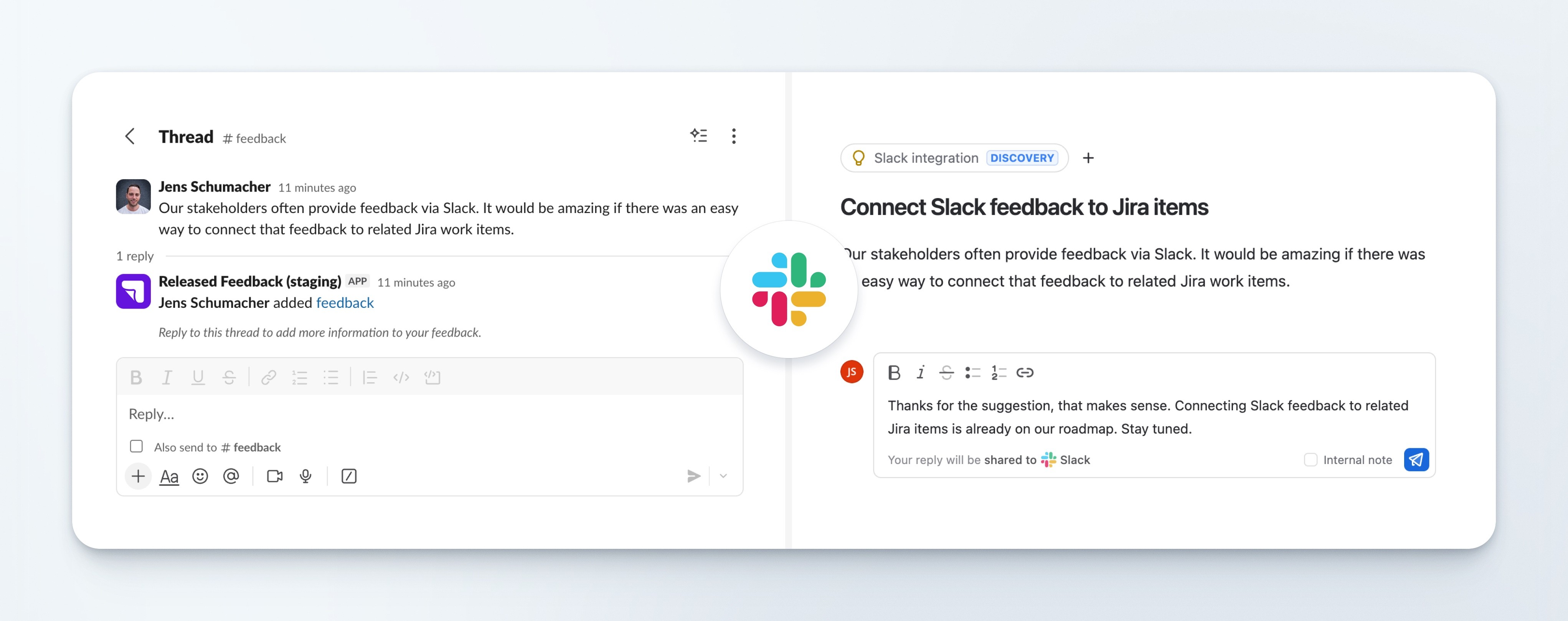
The goal isn’t to replace Slack or Jira. It’s to connect them so feedback moves naturally from conversation to outcome.
Learn more about capturing feedback from Slack
Article
Capture Customer Feedback from Slack and Sync It to Jira
Turn Slack conversations into organized feedback connected to Jira work.
Product teams don’t struggle to collect feedback. They struggle to find it again.
Customer insights show up daily in Slack Connect channels, support threads, internal triage channels, and private DMs. Important context gets discussed, decisions get made, and then the conversation moves on. Weeks later, when it’s time to plan a roadmap or write release notes, teams know the feedback exists but can’t easily surface it.
The problem is that conversations are not structured for product decisions. Without a system to capture and organize what matters, valuable feedback turns into scrollback history.
To fix this, teams need to move beyond periodic surveys and toward continuous listening inside the tools where conversations already happen.
Designing Slack for discoverability
When stakeholders don’t know which channel to use, feedback ends up scattered across DMs, random threads, and unrelated channels. Good ideas slow down before they even reach the product team. The problem isn’t finding information later. It’s giving people a clear place to contribute from the start.
Discoverability starts with a consistent, predictable channel structure.
Channel Prefix | Functional Application | Strategic Importance |
| Centralized intake for specific products. | Standardizes the starting point for suggestions. |
| High-velocity funnels for routing issues. | Prevents decision paralysis by assigning ownership. |
| Collaboration with external partners. | Signals the presence of third parties for security. |
| Read-only updates for broad visibility. | Minimizes noise while ensuring reach. |
In a growing company, if someone has to ask where to give feedback, the system is already failing. Channels should be named after the action people need to take, not internal teams or project codenames. Clear naming lowers friction, increases participation, and ensures feedback actually reaches the people who can act on it.
Slack Connect
For smaller teams, high-touch relationships are a superpower. Slack Connect allows you to invite external partners and customers into your digital headquarters.
Direct Access: Use Slack Connect to ensure high-value customer concerns are understood in real-time.
Beta Testing: Recruit 20 to 50 power users into a shared workspace to gather rapid, iterative feedback during development.
This turns support from a series of transactional tickets into an ongoing relationship. However, this only works if you establish communication norms early and are actively engaging customers.
Managing feedback
Slack is where most feedback already lives. The problem is that conversations don’t organize themselves.
Requests show up across Connect channels, internal threads, and DMs. The same idea gets mentioned multiple times by different customers. Important context sits inside long threads that are hard to find later. When roadmap planning starts, teams end up searching Slack, copying messages into documents, or relying on memory.
The goal isn’t to pull feedback out of Slack. It’s to capture it before it disappears into history.
A practical system does four things well.
Capture feedback where it happens
When a useful message appears, it should take seconds to save it. No forms, no rewriting summaries, no switching tools. The original message, thread context, and author should come along with it.
Bring everything into one place
Feedback comes from everywhere: shared customer channels, internal feedback streams, sales conversations, and stakeholder discussions. Product teams need a single inbox where these signals can be reviewed together instead of scattered across workspaces.
Keep the conversation alive
Organizing feedback shouldn’t remove it from the people who shared it. Replies, follow-ups, and updates should flow back to the original Slack thread so customers and teammates stay informed without extra coordination.
Close the loop when work ships
Feedback only matters if people see outcomes. When an idea turns into a Jira work item and eventually ships, teams should be able to return to the original Slack conversation and share the update in the right thread, even months later. No digging through history or guessing who asked for it. The update reaches the people who care, where the conversation started.
At this stage, feedback isn’t just a conversation anymore, but it’s not development work yet either. It’s something teams can review, group, and prioritize before deciding what moves into Jira.
Putting this into practice
The ideas above don’t require new tools. Clear channel structure, intentional Slack Connect usage, and consistent follow-up already make feedback easier to manage.
But as volume grows, manual systems start to strain. Messages get copied between tools, context is lost, and closing the loop depends on someone remembering where a conversation started.
Released is built to simplify that workflow.
It connects Slack and Jira so feedback can be captured directly from messages, organized in a shared inbox, and linked to the work that ships. When updates go live, teams can notify the original Slack thread automatically, even months later.
The goal isn’t to replace Slack or Jira. It’s to connect them so feedback moves naturally from conversation to outcome.
Learn more about capturing feedback from Slack
Article
Capture Customer Feedback from Slack and Sync It to Jira
Turn Slack conversations into organized feedback connected to Jira work.
Product teams don’t struggle to collect feedback. They struggle to find it again.
Customer insights show up daily in Slack Connect channels, support threads, internal triage channels, and private DMs. Important context gets discussed, decisions get made, and then the conversation moves on. Weeks later, when it’s time to plan a roadmap or write release notes, teams know the feedback exists but can’t easily surface it.
The problem is that conversations are not structured for product decisions. Without a system to capture and organize what matters, valuable feedback turns into scrollback history.
To fix this, teams need to move beyond periodic surveys and toward continuous listening inside the tools where conversations already happen.
Designing Slack for discoverability
When stakeholders don’t know which channel to use, feedback ends up scattered across DMs, random threads, and unrelated channels. Good ideas slow down before they even reach the product team. The problem isn’t finding information later. It’s giving people a clear place to contribute from the start.
Discoverability starts with a consistent, predictable channel structure.
Channel Prefix | Functional Application | Strategic Importance |
| Centralized intake for specific products. | Standardizes the starting point for suggestions. |
| High-velocity funnels for routing issues. | Prevents decision paralysis by assigning ownership. |
| Collaboration with external partners. | Signals the presence of third parties for security. |
| Read-only updates for broad visibility. | Minimizes noise while ensuring reach. |
In a growing company, if someone has to ask where to give feedback, the system is already failing. Channels should be named after the action people need to take, not internal teams or project codenames. Clear naming lowers friction, increases participation, and ensures feedback actually reaches the people who can act on it.
Slack Connect
For smaller teams, high-touch relationships are a superpower. Slack Connect allows you to invite external partners and customers into your digital headquarters.
Direct Access: Use Slack Connect to ensure high-value customer concerns are understood in real-time.
Beta Testing: Recruit 20 to 50 power users into a shared workspace to gather rapid, iterative feedback during development.
This turns support from a series of transactional tickets into an ongoing relationship. However, this only works if you establish communication norms early and are actively engaging customers.
Managing feedback
Slack is where most feedback already lives. The problem is that conversations don’t organize themselves.
Requests show up across Connect channels, internal threads, and DMs. The same idea gets mentioned multiple times by different customers. Important context sits inside long threads that are hard to find later. When roadmap planning starts, teams end up searching Slack, copying messages into documents, or relying on memory.
The goal isn’t to pull feedback out of Slack. It’s to capture it before it disappears into history.
A practical system does four things well.
Capture feedback where it happens
When a useful message appears, it should take seconds to save it. No forms, no rewriting summaries, no switching tools. The original message, thread context, and author should come along with it.
Bring everything into one place
Feedback comes from everywhere: shared customer channels, internal feedback streams, sales conversations, and stakeholder discussions. Product teams need a single inbox where these signals can be reviewed together instead of scattered across workspaces.
Keep the conversation alive
Organizing feedback shouldn’t remove it from the people who shared it. Replies, follow-ups, and updates should flow back to the original Slack thread so customers and teammates stay informed without extra coordination.
Close the loop when work ships
Feedback only matters if people see outcomes. When an idea turns into a Jira work item and eventually ships, teams should be able to return to the original Slack conversation and share the update in the right thread, even months later. No digging through history or guessing who asked for it. The update reaches the people who care, where the conversation started.
At this stage, feedback isn’t just a conversation anymore, but it’s not development work yet either. It’s something teams can review, group, and prioritize before deciding what moves into Jira.
Putting this into practice
The ideas above don’t require new tools. Clear channel structure, intentional Slack Connect usage, and consistent follow-up already make feedback easier to manage.
But as volume grows, manual systems start to strain. Messages get copied between tools, context is lost, and closing the loop depends on someone remembering where a conversation started.
Released is built to simplify that workflow.
It connects Slack and Jira so feedback can be captured directly from messages, organized in a shared inbox, and linked to the work that ships. When updates go live, teams can notify the original Slack thread automatically, even months later.
The goal isn’t to replace Slack or Jira. It’s to connect them so feedback moves naturally from conversation to outcome.
Learn more about capturing feedback from Slack
Use cases
Resources
Backed by


Use cases
Backed by
Use cases
Resources
Backed by