Product
Resources
PricingContact

Article

Why your Slack #feedback channel is leaking (and how to fix it)

Slack is great for capturing feedback. Less great for keeping it.

A familiar ritual plays out in B2B SaaS companies. Someone in sales or support gets tired of pinging the PM directly. The PM gets tired of being pinged. In #general, someone proposes a compromise: "Let's start a #feedback channel and dump everything there."

It feels like a fix for about three weeks. After that, the channel becomes the place where good ideas go to drown.

Why the #feedback channel keeps getting reinvented

The appeal makes sense. Slack is already where work happens, and asking a salesperson to log into a separate tool to capture what a customer just said on a call is a non-starter; they'll forget, or skip it, or paste it into a doc nobody reads. A channel removes friction. Drop a screenshot, tag a quote from a customer call, throw a fire emoji on it, and move on with your day.

Slack itself recommends this pattern: "When sales or support hear feedback from customers or prospects, they typically shoot a message to a #feedback channel in Slack, which the product team monitors with notifications set up." Slack's own product team uses a #features channel where anyone can suggest a feature.

So most teams set the channel up. Notifications get turned on. Stakeholders are encouraged to post. Engagement runs high for a quarter. Everyone feels reasonably good about being customer-centric. Then the cracks show.

What goes wrong

The first failure is volume. A feedback channel doesn't get less busy over time; it gets more. Bug reports, feature wishes, support escalations, ranty Loom links, AE excitement about a deal, and a screenshot of a confusing UI from someone's mom all land in the same firehose. The PM watching the channel has roughly a working day to catch a message before it's effectively gone. One product writer estimated the half-life of Slack feedback at about four hours: "After that it is effectively gone, not deleted, but buried under everything else, unsearchable in any practical sense, and disconnected from every other piece of feedback saying the same thing in a different channel." Practically, that means most of what gets posted in #feedback never gets read a second time.

The second failure is duplication you can't see. A CSM posts that Acme Corp wants SSO. Three weeks later a different AE drops in that a prospect bailed because Acme's competitor offers it. Another CSM mentions on a call recording that "two of my accounts brought up SSO this week." A support engineer files it as a bug. A founder hears it on a sales call and posts it again. In a structured tool, those five inputs would merge into one signal with five votes; in Slack they sit as five disconnected messages, each one decaying, with nobody able to count them. The same Medium piece names the cause well: "Slack was built for communication, not for capturing and synthesizing insight. There is no way to take a message from your CS channel, connect it to a support ticket, connect that to a sales call note, and surface the combined picture to your product team. That connection has to happen manually, which means it almost never happens."

The PMs who do take #feedback seriously usually end up running a second job. Every morning, they scroll the channel, copy interesting items into Jira, paste the customer name and context, link the thread, and write a one-line summary so future-them can understand what it meant. Savio's team documented this homemade pipeline precisely because so many teams have built it from scratch. The approach works for a while. It also costs about thirty minutes a day, falls over the moment that PM goes on holiday, and produces Jira tickets that have shed most of the original customer context along the way. The Slack message stays the source of truth while the Jira ticket becomes a lossy compression of it.

Worse, the submitter rarely hears anything back. The AE who took thirty seconds to post a customer's request gets no reply, no "we're tracking that," nothing to indicate the message was even read. Released's own launch post for its Feedback product names this directly: "Customers often feel like their requests disappear into a void. They send an email or drop a note in the in-app feedback form, and then… never hear back. That's how you lose engagement and trust." The same dynamic plays out internally. After a few months of being ignored, your sales team stops posting at all. The channel goes quiet, which can feel like progress until you realize the feedback is now going nowhere instead of somewhere bad.

Finally, the institutional memory ends up living in one person's head. Eventually the channel produces a tribal expert, usually one PM, who is the only person who actually knows what's in #feedback. They are the human index. When they leave, or get pulled onto a launch, the channel goes dark. Nothing changed in the tool, but the memory walked out the door.

The pattern

Almost every team that tries the #feedback channel hits the same wall. It even shows up in Slack's own guidance for feedback intake. Slack is a great place to capture feedback because that's where your stakeholders already are. It falls apart as a place to keep feedback, because it can't link related messages, dedupe duplicates, prioritize, or close a loop with the person who submitted the thing.
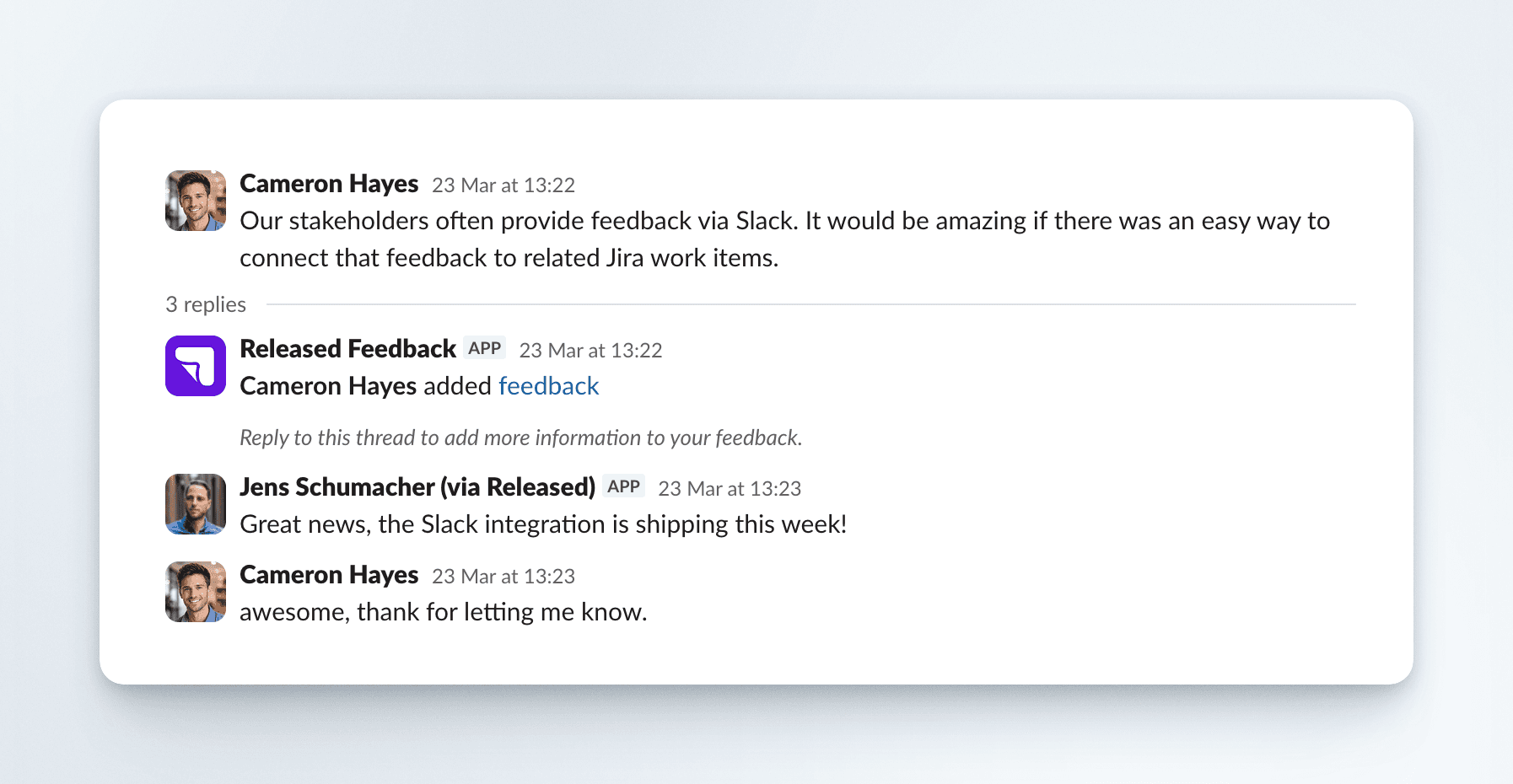
The useful move is to keep the channel and stop treating it as the system of record. Every message worth caring about should become a tracked piece of feedback: linked to a customer, attached to a Jira item, visible to the rest of the product team, and answerable.

How Released handles it

This is what Released's Slack integration is built for. Stakeholders keep posting in Slack the way they already do. Behind the scenes, those messages get turned into structured feedback that flows into Released's inbox alongside feedback from your portal and embedded forms.

A Slack message becomes a feedback item with one click. The original message and thread stay attached, the submitter is preserved, and the item lands in Released's inbox next to feedback from your portal and embedded forms. Sales gets one place to drop things, and PMs get one inbox to triage from.
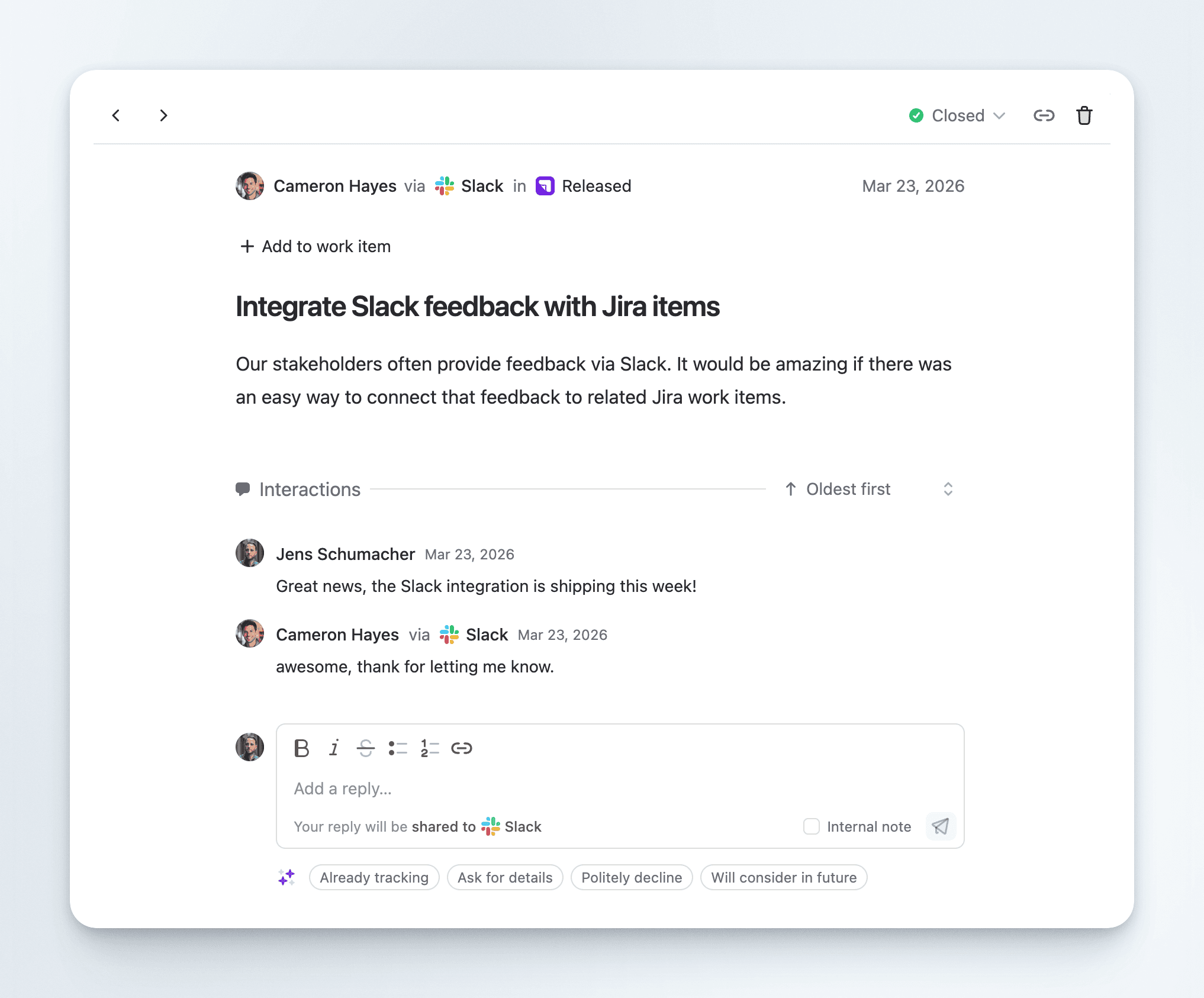
From there, the channel starts to behave differently. Each piece of feedback links to a Jira work item or a Jira Product Discovery idea, so five mentions of "we need SSO" become five pieces of evidence on one Jira issue with the customer names intact. When the Jira work moves, the submitter and the customer see it: in their portal, in their inbox, on the roadmap. And because the signal lives in Jira and Released rather than in one PM's head, new hires can search it and turnover stops resetting your institutional memory.

What you get back is most of why you created the channel in the first place, with the leaks plugged.

You probably don't need to kill #feedback

If your team likes the channel, keep it. The instinct behind it (meet stakeholders where they are, keep friction low, make sharing easy) was right; the mistake was treating the channel itself as the system. Wire it up so that every message worth tracking becomes a tracked piece of feedback, linked to the work, visible to the team, and eventually answered. The channel becomes the front door to a real feedback workflow.

That's probably what your stakeholders thought you were building all along.

Article

Why your Slack #feedback channel is leaking (and how to fix it)

Slack is great for capturing feedback. Less great for keeping it.

A familiar ritual plays out in B2B SaaS companies. Someone in sales or support gets tired of pinging the PM directly. The PM gets tired of being pinged. In #general, someone proposes a compromise: "Let's start a #feedback channel and dump everything there."

It feels like a fix for about three weeks. After that, the channel becomes the place where good ideas go to drown.

Why the #feedback channel keeps getting reinvented

The appeal makes sense. Slack is already where work happens, and asking a salesperson to log into a separate tool to capture what a customer just said on a call is a non-starter; they'll forget, or skip it, or paste it into a doc nobody reads. A channel removes friction. Drop a screenshot, tag a quote from a customer call, throw a fire emoji on it, and move on with your day.

Slack itself recommends this pattern: "When sales or support hear feedback from customers or prospects, they typically shoot a message to a #feedback channel in Slack, which the product team monitors with notifications set up." Slack's own product team uses a #features channel where anyone can suggest a feature.

So most teams set the channel up. Notifications get turned on. Stakeholders are encouraged to post. Engagement runs high for a quarter. Everyone feels reasonably good about being customer-centric. Then the cracks show.

What goes wrong

The first failure is volume. A feedback channel doesn't get less busy over time; it gets more. Bug reports, feature wishes, support escalations, ranty Loom links, AE excitement about a deal, and a screenshot of a confusing UI from someone's mom all land in the same firehose. The PM watching the channel has roughly a working day to catch a message before it's effectively gone. One product writer estimated the half-life of Slack feedback at about four hours: "After that it is effectively gone, not deleted, but buried under everything else, unsearchable in any practical sense, and disconnected from every other piece of feedback saying the same thing in a different channel." Practically, that means most of what gets posted in #feedback never gets read a second time.

The second failure is duplication you can't see. A CSM posts that Acme Corp wants SSO. Three weeks later a different AE drops in that a prospect bailed because Acme's competitor offers it. Another CSM mentions on a call recording that "two of my accounts brought up SSO this week." A support engineer files it as a bug. A founder hears it on a sales call and posts it again. In a structured tool, those five inputs would merge into one signal with five votes; in Slack they sit as five disconnected messages, each one decaying, with nobody able to count them. The same Medium piece names the cause well: "Slack was built for communication, not for capturing and synthesizing insight. There is no way to take a message from your CS channel, connect it to a support ticket, connect that to a sales call note, and surface the combined picture to your product team. That connection has to happen manually, which means it almost never happens."

The PMs who do take #feedback seriously usually end up running a second job. Every morning, they scroll the channel, copy interesting items into Jira, paste the customer name and context, link the thread, and write a one-line summary so future-them can understand what it meant. Savio's team documented this homemade pipeline precisely because so many teams have built it from scratch. The approach works for a while. It also costs about thirty minutes a day, falls over the moment that PM goes on holiday, and produces Jira tickets that have shed most of the original customer context along the way. The Slack message stays the source of truth while the Jira ticket becomes a lossy compression of it.

Worse, the submitter rarely hears anything back. The AE who took thirty seconds to post a customer's request gets no reply, no "we're tracking that," nothing to indicate the message was even read. Released's own launch post for its Feedback product names this directly: "Customers often feel like their requests disappear into a void. They send an email or drop a note in the in-app feedback form, and then… never hear back. That's how you lose engagement and trust." The same dynamic plays out internally. After a few months of being ignored, your sales team stops posting at all. The channel goes quiet, which can feel like progress until you realize the feedback is now going nowhere instead of somewhere bad.

Finally, the institutional memory ends up living in one person's head. Eventually the channel produces a tribal expert, usually one PM, who is the only person who actually knows what's in #feedback. They are the human index. When they leave, or get pulled onto a launch, the channel goes dark. Nothing changed in the tool, but the memory walked out the door.

The pattern

Almost every team that tries the #feedback channel hits the same wall. It even shows up in Slack's own guidance for feedback intake. Slack is a great place to capture feedback because that's where your stakeholders already are. It falls apart as a place to keep feedback, because it can't link related messages, dedupe duplicates, prioritize, or close a loop with the person who submitted the thing.

The useful move is to keep the channel and stop treating it as the system of record. Every message worth caring about should become a tracked piece of feedback: linked to a customer, attached to a Jira item, visible to the rest of the product team, and answerable.

How Released handles it

This is what Released's Slack integration is built for. Stakeholders keep posting in Slack the way they already do. Behind the scenes, those messages get turned into structured feedback that flows into Released's inbox alongside feedback from your portal and embedded forms.

A Slack message becomes a feedback item with one click. The original message and thread stay attached, the submitter is preserved, and the item lands in Released's inbox next to feedback from your portal and embedded forms. Sales gets one place to drop things, and PMs get one inbox to triage from.

From there, the channel starts to behave differently. Each piece of feedback links to a Jira work item or a Jira Product Discovery idea, so five mentions of "we need SSO" become five pieces of evidence on one Jira issue with the customer names intact. When the Jira work moves, the submitter and the customer see it: in their portal, in their inbox, on the roadmap. And because the signal lives in Jira and Released rather than in one PM's head, new hires can search it and turnover stops resetting your institutional memory.

What you get back is most of why you created the channel in the first place, with the leaks plugged.

You probably don't need to kill #feedback

If your team likes the channel, keep it. The instinct behind it (meet stakeholders where they are, keep friction low, make sharing easy) was right; the mistake was treating the channel itself as the system. Wire it up so that every message worth tracking becomes a tracked piece of feedback, linked to the work, visible to the team, and eventually answered. The channel becomes the front door to a real feedback workflow.

That's probably what your stakeholders thought you were building all along.

Article

Why your Slack #feedback channel is leaking (and how to fix it)

Slack is great for capturing feedback. Less great for keeping it.

A familiar ritual plays out in B2B SaaS companies. Someone in sales or support gets tired of pinging the PM directly. The PM gets tired of being pinged. In #general, someone proposes a compromise: "Let's start a #feedback channel and dump everything there."

It feels like a fix for about three weeks. After that, the channel becomes the place where good ideas go to drown.

Why the #feedback channel keeps getting reinvented

The appeal makes sense. Slack is already where work happens, and asking a salesperson to log into a separate tool to capture what a customer just said on a call is a non-starter; they'll forget, or skip it, or paste it into a doc nobody reads. A channel removes friction. Drop a screenshot, tag a quote from a customer call, throw a fire emoji on it, and move on with your day.

Slack itself recommends this pattern: "When sales or support hear feedback from customers or prospects, they typically shoot a message to a #feedback channel in Slack, which the product team monitors with notifications set up." Slack's own product team uses a #features channel where anyone can suggest a feature.

So most teams set the channel up. Notifications get turned on. Stakeholders are encouraged to post. Engagement runs high for a quarter. Everyone feels reasonably good about being customer-centric. Then the cracks show.

What goes wrong

The first failure is volume. A feedback channel doesn't get less busy over time; it gets more. Bug reports, feature wishes, support escalations, ranty Loom links, AE excitement about a deal, and a screenshot of a confusing UI from someone's mom all land in the same firehose. The PM watching the channel has roughly a working day to catch a message before it's effectively gone. One product writer estimated the half-life of Slack feedback at about four hours: "After that it is effectively gone, not deleted, but buried under everything else, unsearchable in any practical sense, and disconnected from every other piece of feedback saying the same thing in a different channel." Practically, that means most of what gets posted in #feedback never gets read a second time.

The second failure is duplication you can't see. A CSM posts that Acme Corp wants SSO. Three weeks later a different AE drops in that a prospect bailed because Acme's competitor offers it. Another CSM mentions on a call recording that "two of my accounts brought up SSO this week." A support engineer files it as a bug. A founder hears it on a sales call and posts it again. In a structured tool, those five inputs would merge into one signal with five votes; in Slack they sit as five disconnected messages, each one decaying, with nobody able to count them. The same Medium piece names the cause well: "Slack was built for communication, not for capturing and synthesizing insight. There is no way to take a message from your CS channel, connect it to a support ticket, connect that to a sales call note, and surface the combined picture to your product team. That connection has to happen manually, which means it almost never happens."

The PMs who do take #feedback seriously usually end up running a second job. Every morning, they scroll the channel, copy interesting items into Jira, paste the customer name and context, link the thread, and write a one-line summary so future-them can understand what it meant. Savio's team documented this homemade pipeline precisely because so many teams have built it from scratch. The approach works for a while. It also costs about thirty minutes a day, falls over the moment that PM goes on holiday, and produces Jira tickets that have shed most of the original customer context along the way. The Slack message stays the source of truth while the Jira ticket becomes a lossy compression of it.

Worse, the submitter rarely hears anything back. The AE who took thirty seconds to post a customer's request gets no reply, no "we're tracking that," nothing to indicate the message was even read. Released's own launch post for its Feedback product names this directly: "Customers often feel like their requests disappear into a void. They send an email or drop a note in the in-app feedback form, and then… never hear back. That's how you lose engagement and trust." The same dynamic plays out internally. After a few months of being ignored, your sales team stops posting at all. The channel goes quiet, which can feel like progress until you realize the feedback is now going nowhere instead of somewhere bad.

Finally, the institutional memory ends up living in one person's head. Eventually the channel produces a tribal expert, usually one PM, who is the only person who actually knows what's in #feedback. They are the human index. When they leave, or get pulled onto a launch, the channel goes dark. Nothing changed in the tool, but the memory walked out the door.

The pattern

Almost every team that tries the #feedback channel hits the same wall. It even shows up in Slack's own guidance for feedback intake. Slack is a great place to capture feedback because that's where your stakeholders already are. It falls apart as a place to keep feedback, because it can't link related messages, dedupe duplicates, prioritize, or close a loop with the person who submitted the thing.

The useful move is to keep the channel and stop treating it as the system of record. Every message worth caring about should become a tracked piece of feedback: linked to a customer, attached to a Jira item, visible to the rest of the product team, and answerable.

How Released handles it

This is what Released's Slack integration is built for. Stakeholders keep posting in Slack the way they already do. Behind the scenes, those messages get turned into structured feedback that flows into Released's inbox alongside feedback from your portal and embedded forms.

A Slack message becomes a feedback item with one click. The original message and thread stay attached, the submitter is preserved, and the item lands in Released's inbox next to feedback from your portal and embedded forms. Sales gets one place to drop things, and PMs get one inbox to triage from.

From there, the channel starts to behave differently. Each piece of feedback links to a Jira work item or a Jira Product Discovery idea, so five mentions of "we need SSO" become five pieces of evidence on one Jira issue with the customer names intact. When the Jira work moves, the submitter and the customer see it: in their portal, in their inbox, on the roadmap. And because the signal lives in Jira and Released rather than in one PM's head, new hires can search it and turnover stops resetting your institutional memory.

What you get back is most of why you created the channel in the first place, with the leaks plugged.

You probably don't need to kill #feedback

If your team likes the channel, keep it. The instinct behind it (meet stakeholders where they are, keep friction low, make sharing easy) was right; the mistake was treating the channel itself as the system. Wire it up so that every message worth tracking becomes a tracked piece of feedback, linked to the work, visible to the team, and eventually answered. The channel becomes the front door to a real feedback workflow.

That's probably what your stakeholders thought you were building all along.

Build what matters

With customer feedback in Jira

Build what matters

With customer feedback in Jira

Build what matters

With customer feedback in Jira